Hand-knotted mulberry silk, silk on silk · round 2.10 m · 900 knots per square inch
015
Masterpiece 015 · Dragon Power
celestial dragon · flaming pearl · gold heart seed
Specs
- Size
- Round 2.10 m
- Silk
- 100% mulberry silk, silk on silk
- Knot
- Hand-knotted, Persian knot
- Density
- 900 knots per square inch (30 × 30)
- Knots
- About 4,830,596
- Pile
- About 4 mm
- Yarns
- 15
- Edition
- One of one
- Status
- Design approved · in production planning
- Design
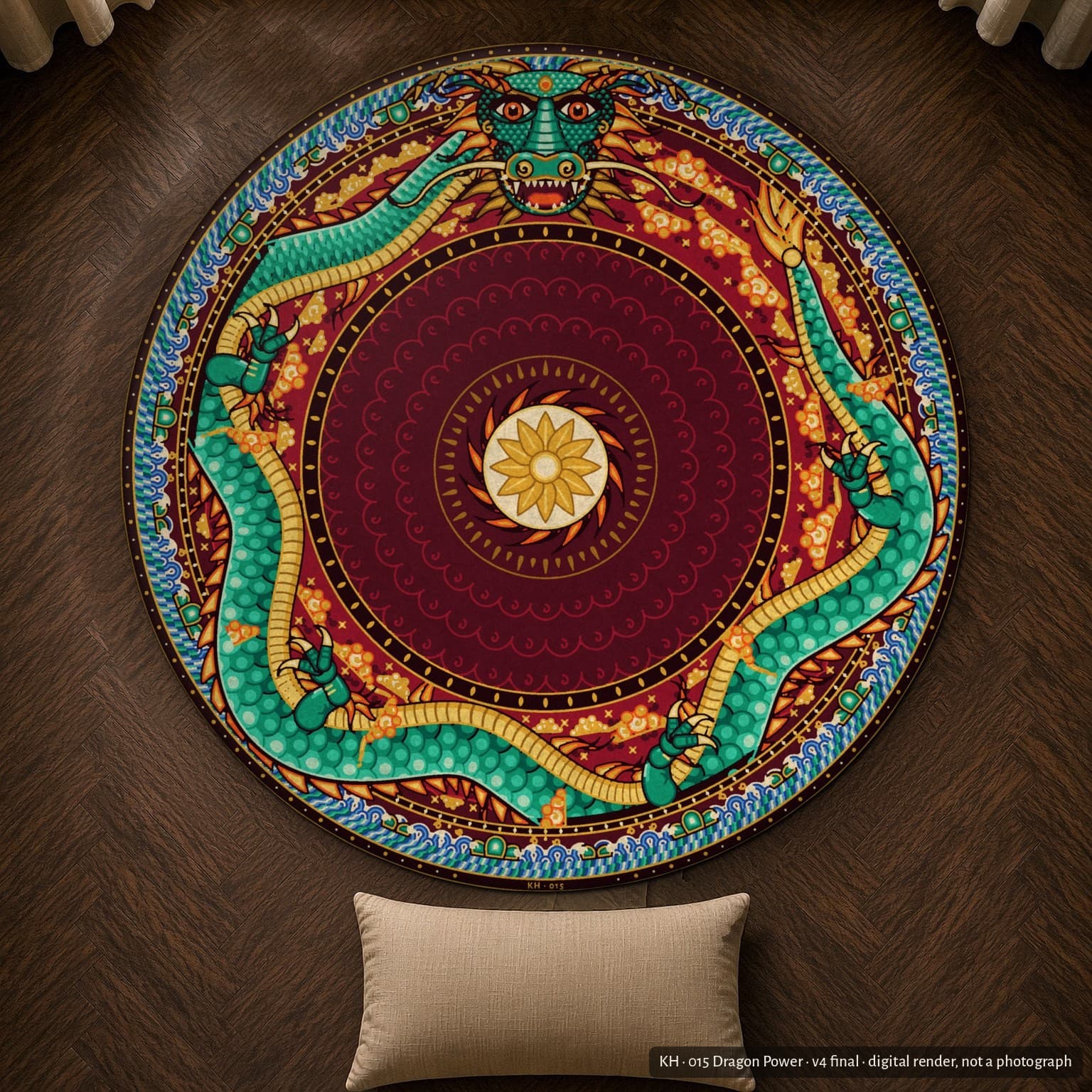
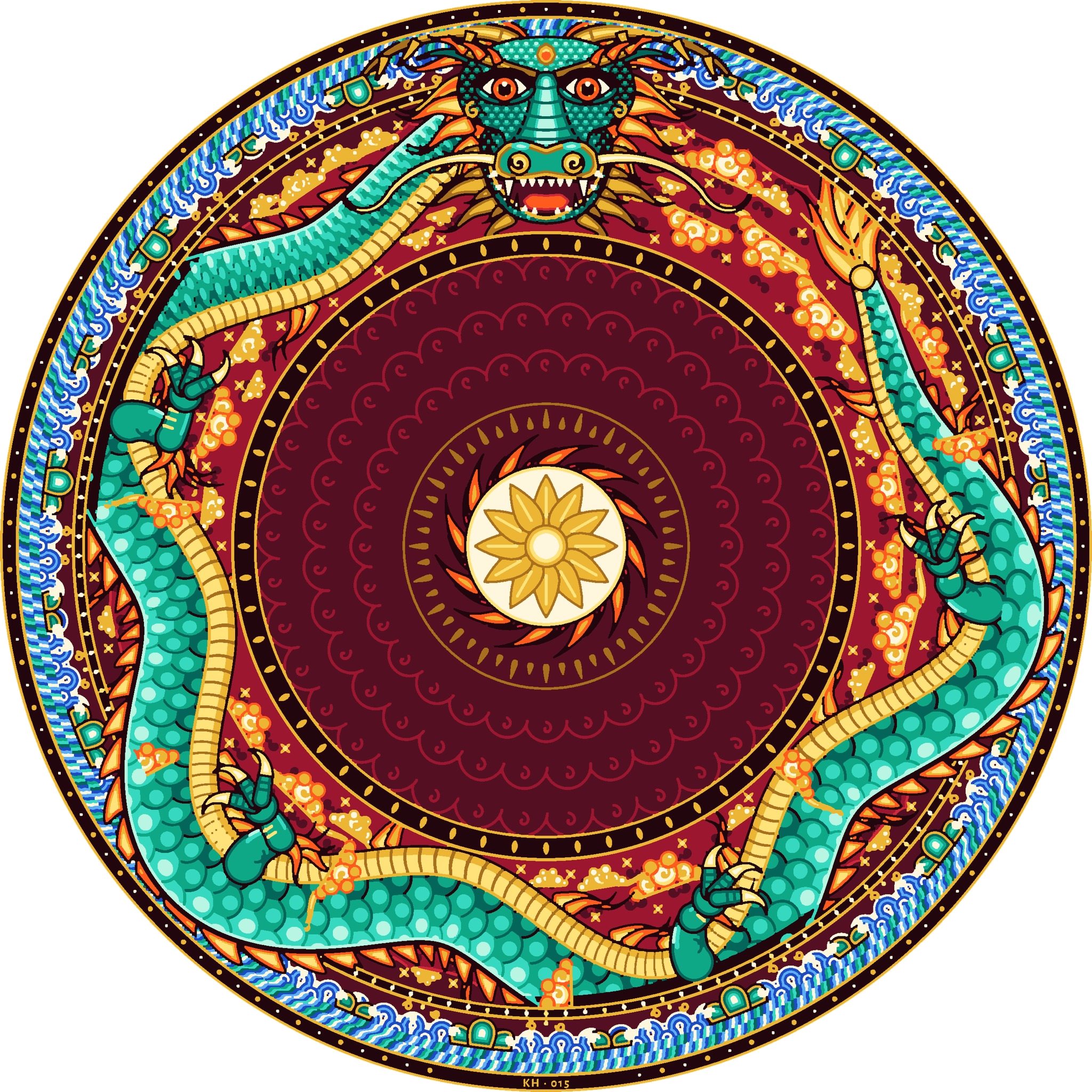
- One celestial dragon circling the seat through clouds, chasing the flaming pearl of wisdom. The pearl is the gold heart seed at the centre, so the sitter sits in the pearl. The dragon's eyes meet the sitter's gaze. The serial KH · 015 sits at 6 o'clock.
- Meditation
- The edge is the body. The field is the mind. The centre is the soul.
Those who made it
Masterpiece 015
Dragon Power
Designed by Khard Hridaya Inc
Toronto, Ontario
Weaver to be recorded as each hand is recorded
Spinner to be recorded as each hand is recorded
Workshop to be recorded as each hand is recorded
Meaning
One celestial dragon of jade and gold surges clockwise around the seat through glowing clouds in a crimson sky, diving behind the frame and bursting over it. At 12 o'clock it rears over the frame and turns to face you, antlers sweeping along the rim, its eyes meeting yours across the flaming pearl: the golden heart seed of every Khard Hridaya rug, wrapped in a ring of fire. Around the rim, waves of lapis and jade break against rounded mountains.
A dragon flies the whole sky searching for the pearl of wisdom. It crosses clouds and storms, dives behind the mountains and bursts over the waves. At last it turns, and finds the pearl shining in the heart of the one who sits still. This is our own telling.
From the sea at the rim of the world the mountains rise, and the waves stand up against them. Above them is a crimson sky, and through it one dragon flies. It comes out of the clouds tail first, a fan of fire near two o'clock. It goes the way the sun goes, diving behind the frame and bursting over it, its scales jade, its belly gold, a crest of flame along its spine. Three claws on each foot, open, holding nothing.
At the top of the world it rears over the frame and turns to face you. Its two great eyes meet yours, its jaws open, its whiskers flare, and before it, always just out of reach, the pearl burns. The pearl does not run. It sits at the heart, in a calm sky of quiet clouds, inside the ring of sixty breaths. The dragon chases; the pearl waits. Whoever sits here sits with the pearl, and the dragon's eyes meet theirs.
In Chinese art the dragon is a benevolent bringer of rain, shown flying among clouds and reaching for a flaming pearl. Writers have read the flaming pearl as a luminary, the sun or the moon, or as an object of great value. The dragon-and-pearl image has also been traced to the Buddhist cintāmaṇi, the wish-fulfilling jewel. On this rug the pearl is the gold twelve-petal heart seed at the centre. Reading the pearl as the sitter's own heart, and the chase as the search for wisdom, is the house's reading.
Druk means thunder dragon. Bhutan's name for itself, Druk Yul, goes back to the Drukpa school: in about 1206 Tsangpa Gyaré is said to have seen nine dragons rise into the sky with thunder, and named his monastery and his lineage after them. In this lore thunder is the dragon's voice. On Bhutan's flag a white dragon holds jewels in its claws.
In Mongolian belief the luu is a heavenly dragon. Thunder is the voice of the luu, and lightning comes from the movement of its tail. On this rug the tail ends in a soft fan of flame, and flames stream off the body. That is a design choice, a nod to the thunder and the lightning.
The clouds are cream ruyi-headed clouds with gold curls. Most sit behind the dragon, and six pass in front of its body. The band of standing water, rolling waves and rising rocks is a classic border of Ming and Qing court robes, the enduring land rising from the sea. Here the mountains alternate as triple and double rounded rocks, and the stripes cycle lapis, sky, cream, jade and turquoise.
This dragon has three claws, to echo the older, unranked dragon and to avoid any suggestion of rank. Its head is frontal, so the dragon looks straight at whoever sits at the centre. Front-facing dragons once marked higher rank on Qing rank badges and court robes. That is history only. No rank or status is claimed.
The edge is the body: a gold-ruled night-garnet guard set with 72 gold beads and the serial KH · 015 at 6 o'clock, then the wave-and-mountain band, ending at a pearl-studded inner guard. The field is the mind: one great dragon, jade and gold, surging clockwise through a crimson sky of glowing clouds. The centre is the soul: a seat 1.20 m across that holds no figure, a ring of sixty gold breath marks, and the flaming pearl, the gold twelve-petal heart seed on a cream pearl, wrapped in fire.
The dragon searches the sky; the pearl was always here.
Meeting the Dragon's Gaze is Khard Hridaya's own practice, not a traditional one.
Sit in the seat circle with the serial KH · 015 behind you, facing the dragon's head. Rest your hands in your lap, breathe naturally through the nose, and take 3 slow breaths.
Raise your eyes to meet the dragon's eyes. Stay with its gaze for 9 breaths, eyes soft, blinking freely.
Close your eyes. Feel the flaming pearl beneath you as a small warm light at your heart, for 9 breaths.
Open your eyes. Starting at the dragon's head, follow the 60 breath marks clockwise, one natural breath per mark.
Meet the dragon's eyes once more, bow slightly, and rest a moment before you stand.
Dragon meditation is not a single classical practice. Traditional dragons live in movement forms and as symbols, and the popular guided versions are modern.
Beauty and presence.
Permanent record
The permanent record opens when this design goes to the loom.
Certificate of Authenticity KH-COA-015
The certificates await founder approval.